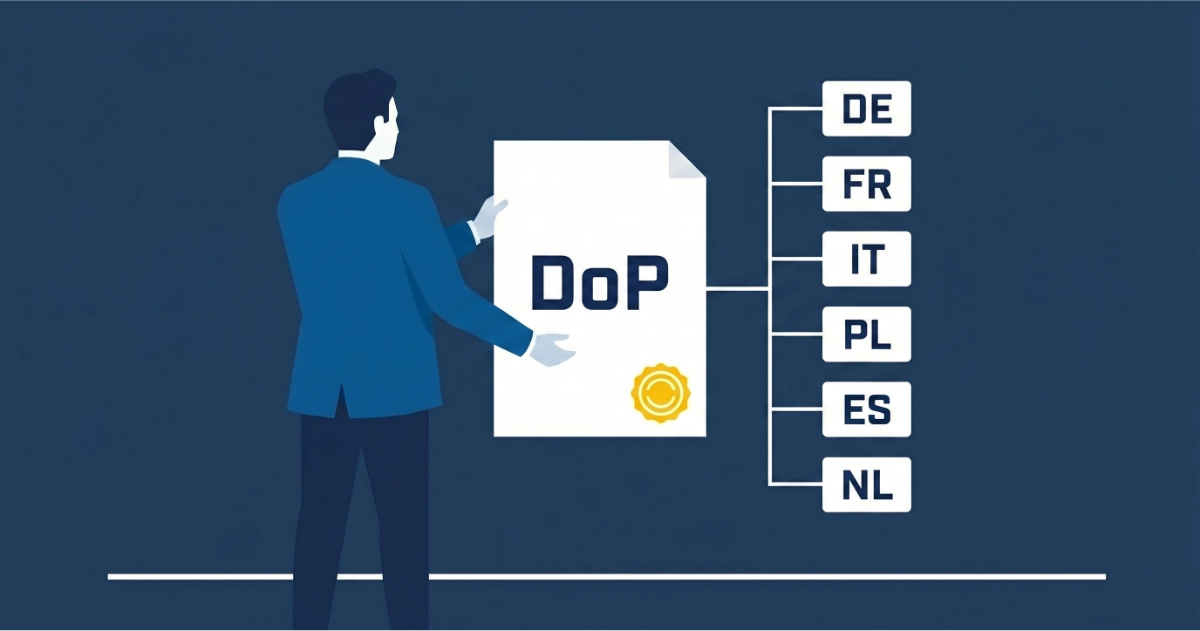
The Construction Products Regulation (CPR) sets strict requirements for the linguistic accessibility of technical documentation. According to Article 16(4) of Regulation (EU) 2024/3110, a manufacturer must supply the Declaration of Performance (DoP) in the language or languages required by each Member State where the product is made available. Furthermore, all instructions and safety information must be provided in a language easily understood by users, as determined by the relevant Member State.
Local market surveillance authorities, customs, and distributors have the legal power to verify these documents against national requirements. If a DoP is not available in the local language, or if the translation contains technical discrepancies, the product can be prohibited from being made available on the market. Compliance is not a one-time event; it is a continuous obligation that must be maintained across all languages for the duration of the product’s market life.
The Math of Document Sprawl
Most manufacturers currently manage this requirement using a “Save As” methodology in Word or spreadsheet templates. The operational math of this approach is unsustainable as a company scales. If a manufacturer manages 100 product types and distributes them across five EU Member States, they must maintain 500 separate static files.
Every time a harmonised technical specification is updated, or a production process change triggers a reassessment, the manufacturer faces a massive administrative burden. The volume of files destroys version control, as there is no central source of truth. Technical documentation managers spend more time on formatting and file management than on ensuring the accuracy of the underlying performance data.
The Risk of Disconnected Data
Static PDF workflows treat the document as the data, which leads to disconnected technical values across different language versions. Essential characteristics such as “Reaction to Fire” or “Release of Dangerous Substances” are expressed through specific classes or numerical levels. When these values are manually typed into localised templates, the risk of human error is high.
A discrepancy between a Spanish and a German DoP for the same unique identification code of the product type is a formal non-compliance. Under the new CPR, manufacturers are liable for incorrect or diverging declarations. If market surveillance detects that a product’s declared performance varies by country, it suggests a failure of the manufacturer’s internal factory production control (FPC), potentially triggering an audit.
The Structured Translation Layer: Pelicopy’s Architecture
Pelicopy resolves document sprawl by moving away from document-centric workflows and toward a structured data architecture. In this model, technical data is separated from the language labels. A product exists in the system as a single master data profile. Technical values — such as a fire class of “A1” or a thermal conductivity value of “0.040 W/mk” — are stored as language-agnostic data points.
The text associated with these values (e.g., “Reaction to fire” or “Brandverhalten”) exists in a separate translation layer. When a manufacturer needs to generate a DoP in a new language, they do not rebuild the document. Instead, they apply a new set of language labels to the existing master data.
If a performance value changes, the engineer updates it once in the master profile. Pelicopy’s architecture ensures that this change is instantly reflected across all language outputs. While human translators are still required to ensure the accuracy of the initial language labels, they no longer need to touch the technical values themselves. This separation enforces strict data integrity: the technical truth of the product remains identical, regardless of the language in which it is viewed.
Operational Scalability Across Borders
Transitioning to a structured data platform shifts the effort of European market expansion from an administrative task to a focused translation project. Entering a new Member State no longer requires the creation of hundreds of new files. Instead, the manufacturer simply defines the required language in Pelicopy and provides the localised strings for the field labels.
This architecture is inherently compatible with the incoming Digital Product Passport (DPP) requirements. The DPP requires that information be machine-readable, searchable, and structured. By managing DoP data in a structured format today, manufacturers eliminate the need for a future, emergency overhaul of their documentation systems. They move from a state of document multiplication to a state of data-driven compliance, where the focus remains on product performance rather than file management.
To see how Pelicopy manages multilingual documentation in practice, request a trial account.